
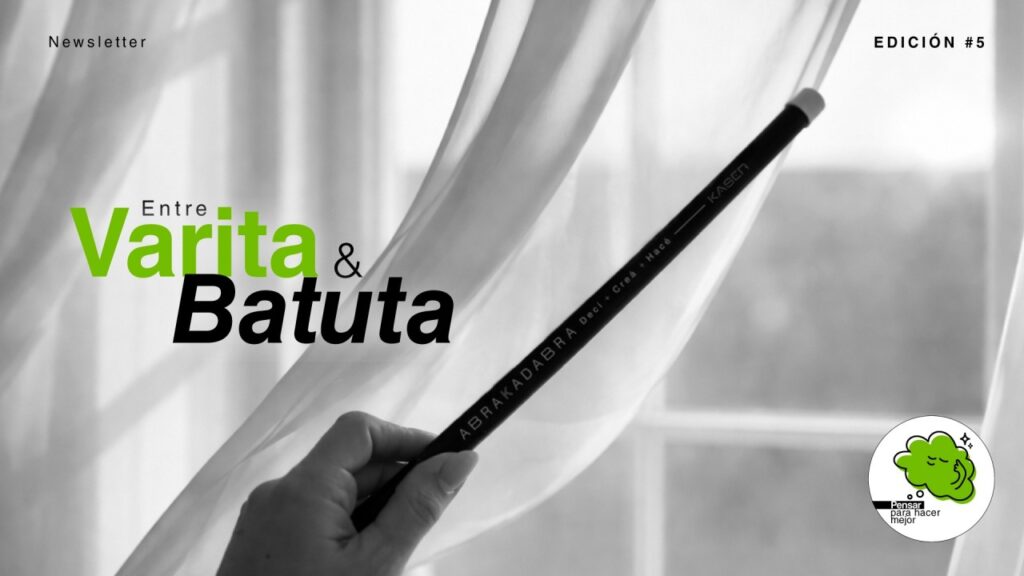


Today I was playing again with the magic wands we made in Kaser for New Year’s Eve.
Abrakadabra as a concept. Creating while you speak. Believing while you speak.
As I turned it between my fingers, I thought, “This could also be a baton.”
Recently, someone I deeply admire told me, “It’s difficult to be the leader.” This person doesn’t come from the business world, and is one of the most incredibly humane people I know. One of those people whose intelligence, as Victoria Ocampo said, is not just intellectual, but also grounded in life.
And that phrase kept echoing in my mind…
To lead is an old-fashioned, almost vintage expression. But the difficulty it describes is anything but. Because leading is more than conducting. It’s about setting a rhythm in a world that’s out of sync . It’s about trying to bring order when each instrument has its own urgency, its own tempo, its own noise.
Was it always difficult? Probably so.
But today, the role of the leader is more exposed, observed, and questioned. Before, authority was a given. Today , it is built and constantly reviewed .
Leading today means maintaining control without rigidity. It means making decisions knowing that not all of them will be applauded. And it means accepting that leadership isn’t about being liked, but about taking responsibility.
Perhaps that’s why the phrase carries more weight now. Because leadership has become a fragile balance between listening and deciding. Between opening up the process and closing ranks. Between supporting and, sometimes, being left alone.
Along that path, one hardens, and sometimes becomes uncomfortable. For a long time, we’ve associated hardness with a lack of humanity and softness with weakness. But what if hardening isn’t becoming cold, but rather firm? What if softening isn’t being weak, but allowing oneself to be more sensitive?
Taking the lead also means knowing when to tighten and when to loosen up. When to hold a position and when to change it.
It’s not magic, but it’s close enough.
Between the wand and the baton, there’s something in common: both require intention . A gesture that activates something in others. And the one who wields the baton also needs moments of wielding the wand. Spaces to rediscover belief, to imagine without structure, and to perform their own abracadabra before once again setting the rhythm.
Perhaps leading today is about that: learning to alternate. Instead of remaining in control, or relying on magic, daring to use both , depending on the moment.
The question remains open, and I’m interested in your response. If you lead teams, projects, or processes, how have you adapted your approach to setting the pace?